27/04/2021
This is one of the comments of UNDP in the report “Research and Assessment on the awareness and the implementation of responsible business practices in Vietnam’s enterprises ”, which was published on 22/4/2021.
The report points out that “The level of awareness of responsible business practices among Vietnamese firms, especially domestic private firms, remains low. 42% of businesses surveyed think that in a narrower sense, responsible business is performing corporate social responsibility (7%) or complying with the laws of the country (35%). Regarding the level of responsible business performance, up to 62% of enterprises only fully comply with the provisions of Vietnamese law, and up to 27% of enterprises do not fully comply with legal requirements of the law. The larger the enterprise, the deeper participation and integration into the global supply chain, the higher the level of responsible business practice.
Responsible business is a global trend which increasingly influences Vietnam. Responsible business practices are becoming urgent, especially in the context of Vietnam when the country deeply and widely integrates into the world economy with the ratification of the two recent Free Trade Agreements, which are EVFTA and CPTPP. Participating in the global supply chain presents many challenges and opportunities for Vietnam, especially opportunities for responsible business practices, towards the sustainable development of the economy and society.
The COVID 19 pandemic causes a great shock to the global economy, and Vietnam can not stand out of that spiral. COVID 19 seems to increase the systemic trauma of the Vietnamese economy, making the need for a strong and sustainable recovery to be urgent. This requires businesses to proactively take responsibility for respecting human rights, proactively practice responsible business with society, with the community, with the environment and with the ecosystem in which businesses are operating in.
From 2018 – 2021, the Center for Development and Integration (CDI) cooperated with the Friedrich-Ebert-Stiftung Institute (FES) to implement the project “Business and Human Rights in Trade Relations and Global Supply Chain in Vietnam” which is funded by the European Union. One of the main objectives of the project is to raise awareness and promote the implementation of the United Nations Human Rights and Business Guiding Principles (UNGP) and to support the implementation of the Trade and Sustainable Development Chapter (Chapter 13) of the Vietnam – European Union Free Trade Agreement (EVFTA).
Within the framework of the project, CDI works together with FES to promote responsible business, through a number of key activities:
- Compile the United Nations Guiding Principles on Business and Human Rights (UNGP), including three brochures on UNGP Basic Information for business, trade unions and lawyers; and 2 Handbooks on Implementing Guiding Principles on Business and Human Rights – A Reference for Corporate and Social Organizations. 2 handbooks have been compiled to help businesses and social organizations (SOs) understand and fulfill their responsibility to respect human rights according to the United Nations Guiding Principles on Business and Human Rights (UNGP).
Document link:
https://bhrvietnam.net.vn/en/tai-lieu-huong-dan-thuc-thi-ungp-danh-cho-to-chuc-xa-hoi-va-doanh-nghiep/
https://bhrvietnam.net.vn/en/871-2/
- Cooperate with the Enterprise Development Institute (EDF) under VCCI to conduct 3 training courses on UNGP for textile and footwear enterprises. The main content of the training is to help businesses to see the benefits, not only in the short term but also in the long term, when doing responsible business practices.
- Compile documents on grievance redress mechanisms for workers in the supply chain (Mechanism to deal with problems which workers encounter in the workplace).
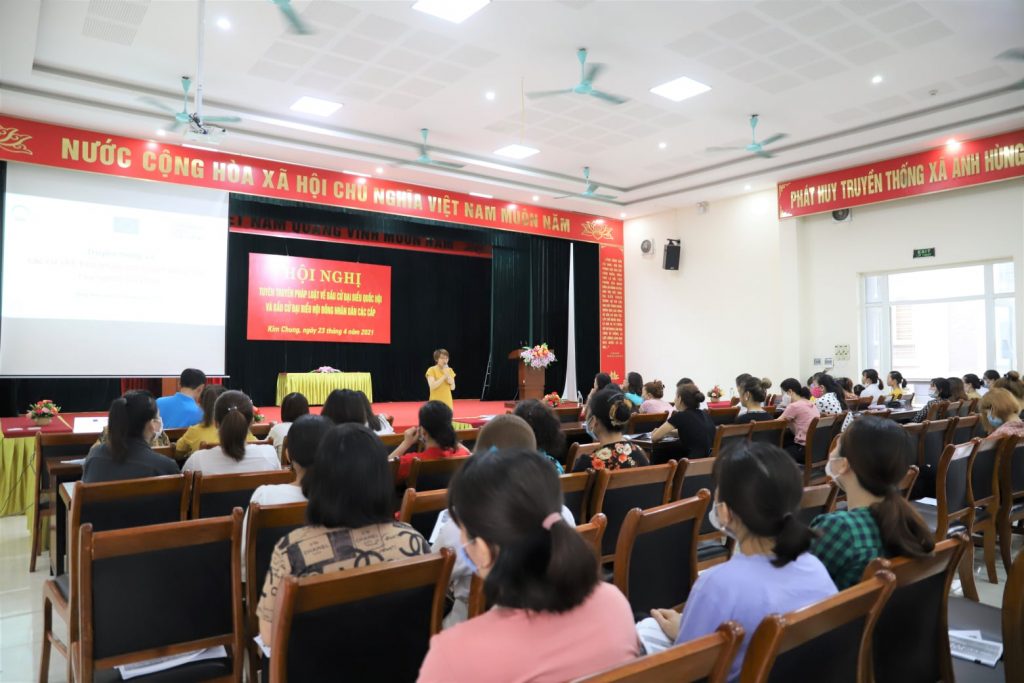
- Organized 18 sessions of communication to raise awareness and legal advice for employees on mechanisms for receiving and handling complaints, in 6 localities, including Dong Nai, Ho Chi Minh City, Hai Duong, Hai Phong, Bac Ninh and Hanoi.
- Cooperate with VITAS Textile Enterprises Association to organize 3 training courses on Social Dialogue Mechanism between employees and employers. In which, social dialogue is considered as part of the mechanism of receiving and handling complaints, in order to promote communication, exchange and feedback between employees and employers, as well as to promote the representativeness of workers and accountability and transparency of information of employers. The implementation of Social Dialogue is also contributing to ensure responsible business of the enterprise.